

Forward Deployed Engineers: Bridging the Gap Between Customers and Product Engineering
Forward Deployed Engineers (FDEs) are reshaping modern software development by bridging the gap between customers and product engineering. Combining technical expertise with real-world problem solving, they help companies deploy solutions more effectively.
As software systems grow more complex and organizations adopt advanced technologies like AI and distributed platforms, a new role is gaining serious traction in the tech industry: the Forward Deployed Engineer (FDE).
Unlike traditional engineers who primarily focus on building products internally, FDEs operate at a unique intersection where engineering meets real-world customer problems.
This shift is quietly reshaping how modern software teams build, deploy, and evolve their products.
What is a Forward Deployed Engineer?
A Forward Deployed Engineer (FDE) is a software engineer who works directly with customers to implement, customize, and optimize complex systems in real-world environments.
The role became well-known through companies like Palantir, where engineers were embedded alongside customers to build tailored solutions using internal platforms.
Instead of working in isolation, FDEs actively collaborate with users to:
- Understand real-world challenges
- Design solutions using existing systems
- Build integrations across platforms
- Customize workflows
- Ensure successful deployments
In essence, an FDE is a hybrid of:
- Software Engineer
- Solutions Architect
- Technical Consultant
Why This Role Emerged
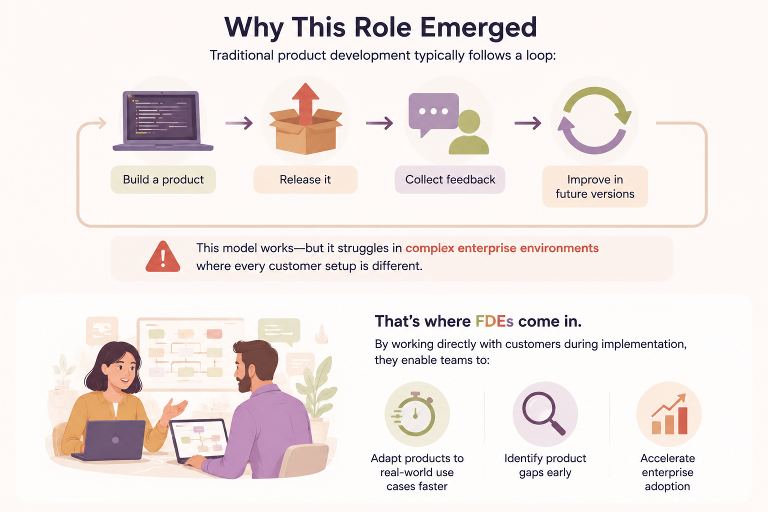
Traditional product development typically follows a loop:
- Build a product
- Release it
- Collect feedback
- Improve in future versions
This model works but it struggles in complex enterprise environments where every customer setup is different.
That’s where FDEs come in.
By working directly with customers during implementation, they enable teams to:
- Adapt products to real-world use cases faster
- Identify product gaps early
- Accelerate enterprise adoption
Core Responsibilities of Forward Deployed Engineers
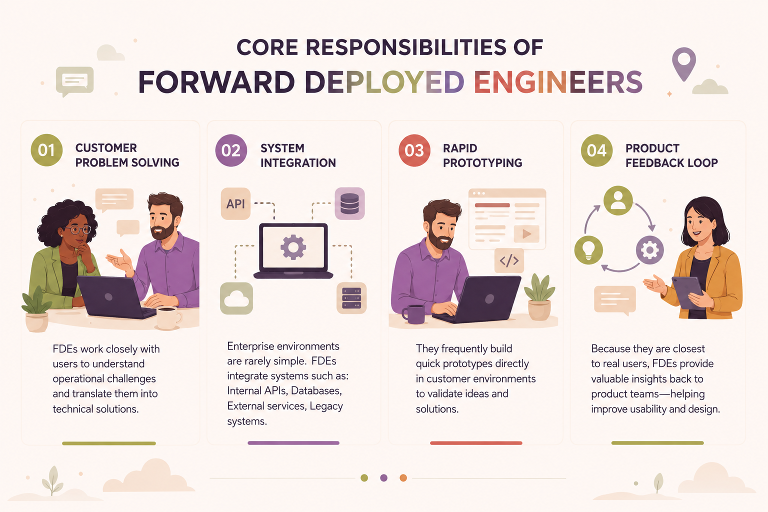
While responsibilities vary across companies, most FDEs focus on four key areas:
1. Customer Problem Solving
FDEs work closely with users to understand operational challenges and translate them into technical solutions.
One of the most critical parts of this process is solution design.
FDEs are responsible for designing practical architectures that fit customer environments rather than forcing customers to adapt to rigid product limitations.
This often involves:
- Mapping existing enterprise workflows
- Identifying operational bottlenecks
- Designing scalable integration patterns
- Defining data flow between systems
- Choosing the right deployment strategies
Unlike traditional software engineering, where requirements are usually predefined, FDEs frequently operate in ambiguous environments where the solution itself still needs to be discovered.
This makes architectural thinking and system design a core part of the role.
2. System Integration
Enterprise environments are rarely simple. FDEs integrate systems such as:
- Internal APIs
- Databases
- External services
- Legacy systems
FDEs must often design integration architectures capable of handling fragmented enterprise ecosystems.
In many organizations, systems were built over years using different technologies, protocols, and infrastructure models. The FDE becomes responsible for designing a unified solution that allows these systems to communicate effectively.
This includes considerations such as:
- API orchestration
- Event-driven architectures
- Authentication and security boundaries
- Data synchronization strategies
- Fault tolerance and resiliency
- Scalability under production workloads
Because of this, FDEs frequently act as both engineers and solution designers during deployments.
3. Rapid Prototyping
They frequently build quick prototypes directly in customer environments to validate ideas and solutions.
4. Product Feedback Loop
Because they are closest to real users, FDEs provide valuable insights back to product teams helping improve usability and design.
How FDEs Differ from Traditional Roles
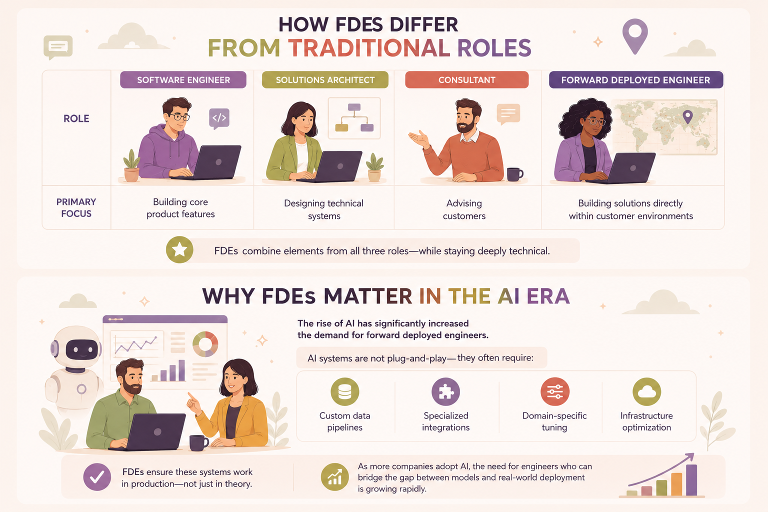
Role Primary Focus Software Engineer Building core product features Solutions Architect Designing technical systems Consultant Advising customers Forward Deployed Engineer Building solutions directly within customer environments
FDEs combine elements from all three roles while staying deeply technical.
Why FDEs Matter in the AI Era
The rise of AI has significantly increased the demand for forward deployed engineers.
AI systems are not plug-and-play they often require:
- Custom data pipelines
- Specialized integrations
- Domain-specific tuning
- Infrastructure optimization
Modern AI deployments introduce an additional layer of architectural complexity.
AI systems rarely operate as isolated models. In production environments, they must integrate with:
- Enterprise databases
- Vector stores
- Internal APIs
- Workflow systems
- Monitoring platforms
- Security and compliance layers
Designing these AI-enabled architectures has become a major responsibility for modern FDEs.
They are often required to determine:
- Where inference should occur
- How data should flow securely
- Which components should be cached
- How latency can be minimized
- How systems remain reliable under scale
In many cases, the success of an AI initiative depends less on the model itself and more on how well the surrounding system architecture is designed.
FDEs ensure these systems work in production not just in theory.
As more companies adopt AI, the need for engineers who can bridge the gap between models and real-world deployment is growing rapidly.
Skills Required to Become an FDE
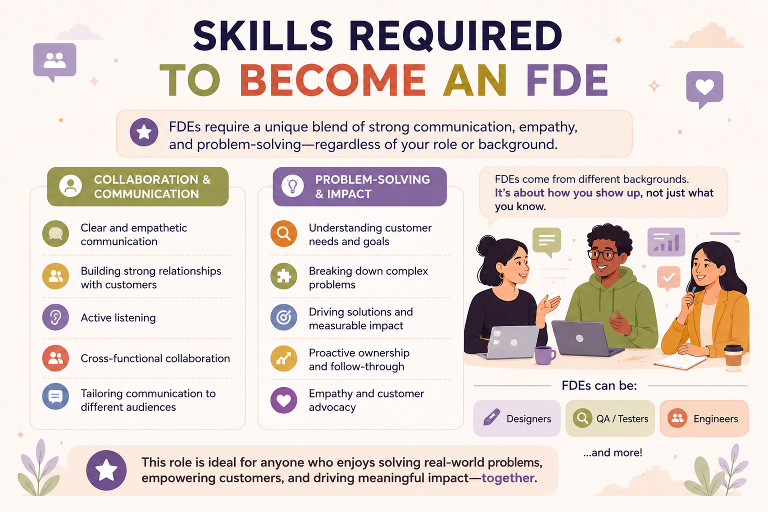
FDEs need a rare combination of technical depth and communication skills.
Technical Skills
- Backend development
- API design
- System architecture
Integration Expertise
- Data pipelines
- Microservices
- Cloud infrastructure
Customer-Facing Skills
- Clear communication
- Requirement discovery
- Problem framing
Problem-Solving Ability
- Debugging complex systems
- Building fast, practical solutions
This role is ideal for engineers who enjoy solving real-world problems not just writing code in isolation.
The Future of Forward Deployed Engineering
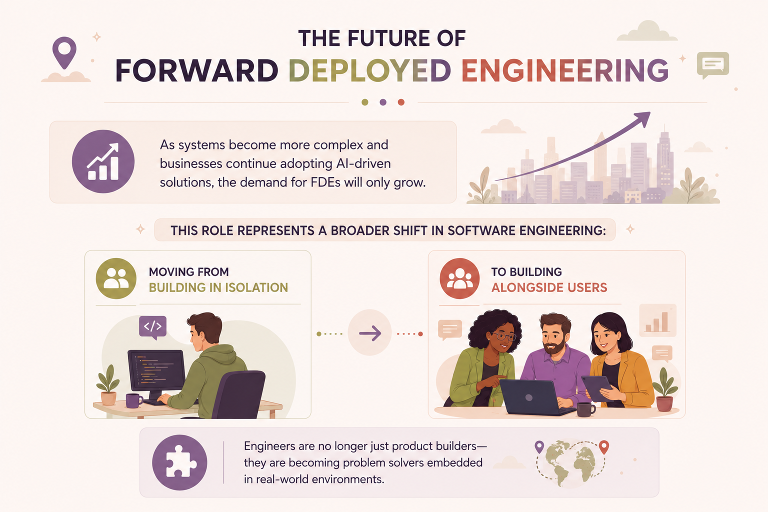
As systems become more complex and businesses continue adopting AI-driven solutions, the demand for FDEs will only grow.
This role represents a broader shift in software engineering:
Moving from building in isolation → to building alongside users.
Engineers are no longer just product builders they are becoming problem solvers embedded in real-world environments.
Final Thoughts
Forward Deployed Engineers play a critical role in modern tech organizations by connecting product development with real-world execution.
By combining engineering expertise, solution architecture capabilities, and deep customer collaboration, they ensure that complex systems deliver actual value not just theoretical capabilities.
As the industry evolves, the FDE role is poised to become one of the most impactful positions in software engineering.
Disandu Perera
Trainee Software Engineer