

The Rise of AI-Driven Agile Development: Exploring the BMAD Method
As AI continues to transform software development, new frameworks like the BMAD Method are redefining how teams build and deliver products. By introducing role-based AI agents and structured workflows, this approach offers a glimpse into the future of AI-driven agile development.
The Problem with Traditional AI Coding Assistants
Today’s AI tools are powerful but limited in scope.
They can:
- Generate code snippets
- Explain logic
- Suggest fixes
- Refactor code
But they don’t think like a team
Building real systems requires coordination between multiple roles:
- Product managers defining requirements
- Architects designing systems
- Developers implementing features
- QA engineers ensure quality
- Security Engineers identifying vulnerabilities, enforcing compliance, and embedding security throughout the development lifecycle
Traditional AI tools don’t replicate this structure they act as a single contributor, not a collaborative unit.
What is the BMAD Method?
The BMAD Method is an AI-driven agile framework that simulates a full development team using multiple specialized agents.
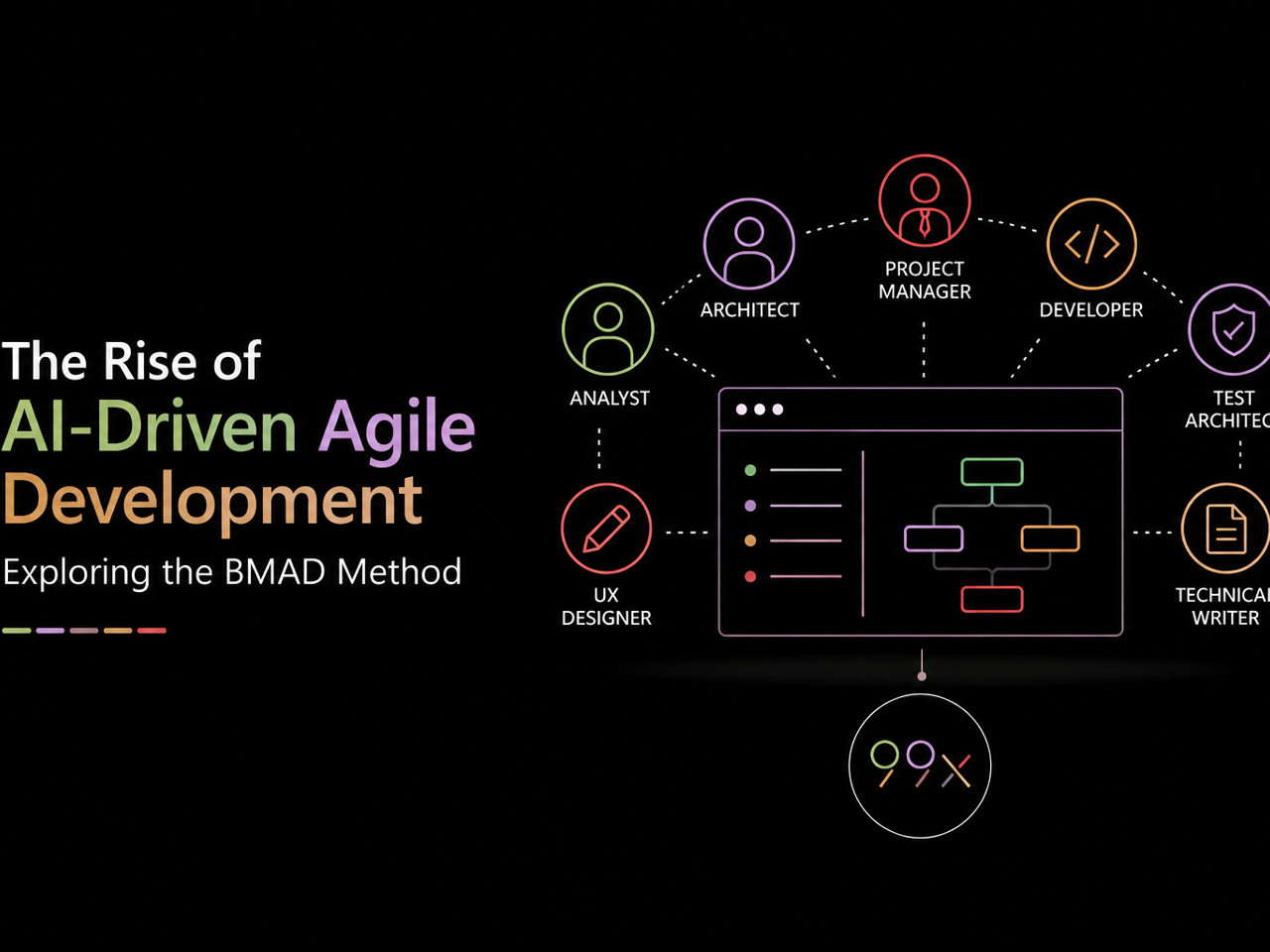
Instead of one AI assistant, it introduces role-based agents such as:
- Analyst
- Project Manager
- Architect
- Developer
- Test Architect
- UX Designer
- Technical Writer
Each agent contributes to the process, just like in a real agile team.
The Core Idea: Agent-Driven Development
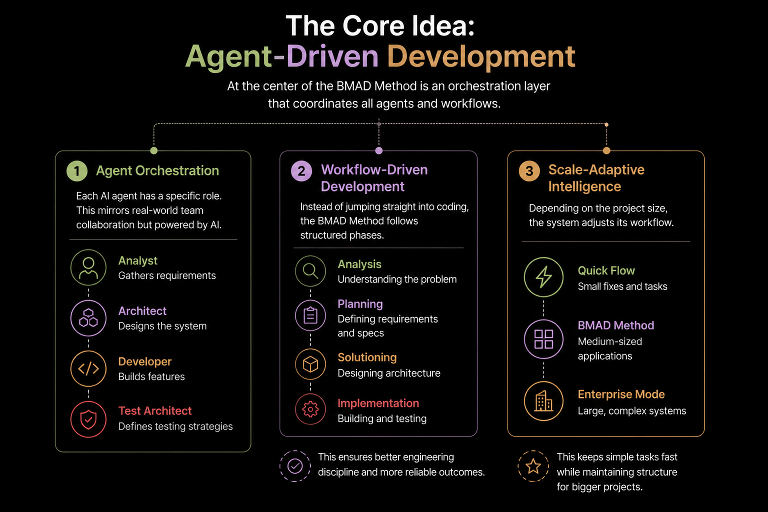
At the center of the BMAD Method is an orchestration layer that coordinates all agents and workflows.
1. Agent Orchestration
Each AI agent has a specific role.
For example:
- The Analyst gathers requirements
- The Architect designs the system
- The Developer builds features
- The Test Architect defines testing strategies
This mirrors real-world team collaboration but powered by AI.
2. Workflow-Driven Development
Instead of jumping straight into coding, the BMAD Method follows structured phases:
- Analysis → Understanding the problem
- Planning → Defining requirements and specs
- Solutioning → Designing architecture
- Implementation → Building and testing
This ensures better engineering discipline and more reliable outcomes.
3. Scale-Adaptive Intelligence
One of the most interesting aspects is adaptability.
Depending on the project size, the system adjusts its workflow:
- Quick Flow → Small fixes and tasks
- BMAD Method → Medium-sized applications
- Enterprise Mode → Large, complex systems
This keeps simple tasks fast while maintaining structure for bigger projects.
Why This Approach Matters
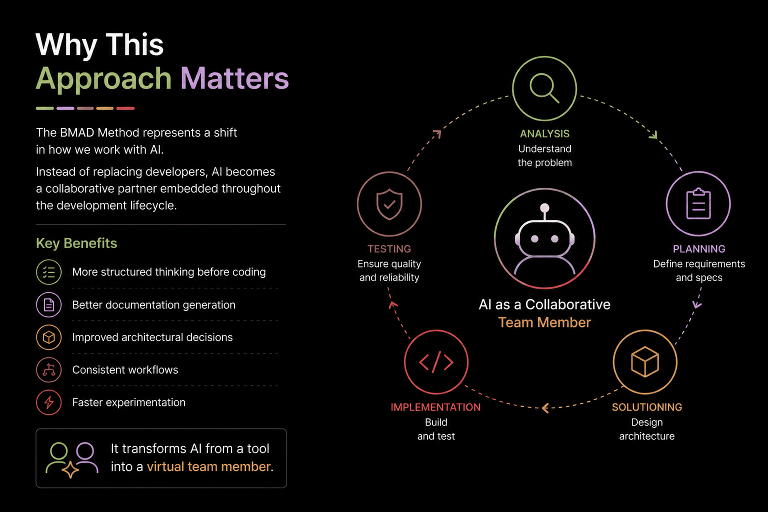
The BMAD Method represents a shift in how we work with AI.
Instead of replacing developers, AI becomes a collaborative partner embedded throughout the development lifecycle.
Key benefits include:
- More structured thinking before coding
- Better documentation generation
- Improved architectural decisions
- Consistent workflows
- Faster experimentation
It transforms AI from a tool into a virtual team member.
Beyond Software Development
Although designed for software engineering, the concept is much broader.
The same agent-based approach can be applied to:
- Business strategy
- Research workflows
- Product design
- Education
- Creative processes
Essentially, any domain that benefits from structured collaboration can adopt this model.
What This Means for the Future
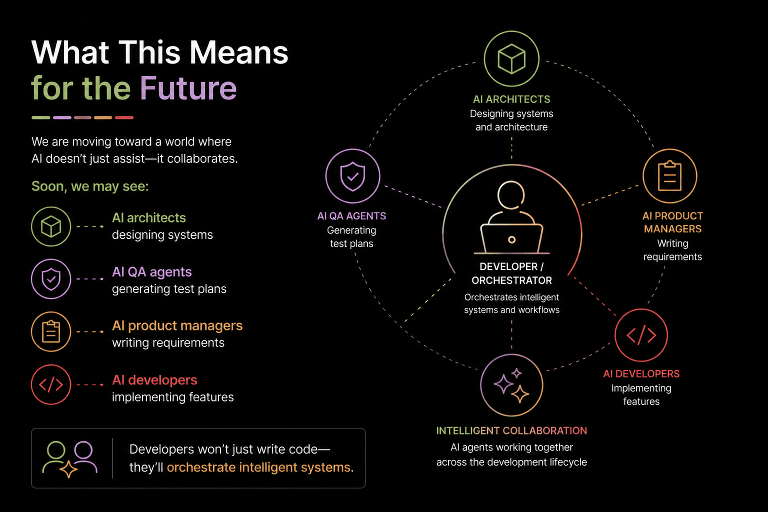
We are moving toward a world where AI doesn’t just assist it collaborates.
Soon, we may see:
- AI architects designing systems
- AI QA agents generating test plans
- AI product managers writing requirements
- AI developers implementing features
Developers won’t just write code — they’ll orchestrate intelligent systems.
Final Thoughts
The BMAD Method gives us a glimpse into the future of software development.
The real innovation isn’t just smarter AI it’s how AI works together.
As these systems evolve, the biggest opportunity lies in combining:
- Human creativity
- Structured AI workflows
That combination has the potential to redefine how we build software faster, smarter, and more collaboratively than ever before.
Disandu Perera
Trainee Software Engineer